Your platform environment is probably under-scoped for SOX. This is the method that fixes it.
A printable field guide that takes IT SOX and audit teams from "is this even a platform environment?" to a documented, defensible, testable scope, without stretching a traditional ITGC checklist to fit.
Built for environments running on cloud, identity providers, CI/CD pipelines, and data platforms, where the numbers are computed in systems no one logs into.
Traditional SOX scoping was built for a house. You're scoping a building complex.
Application-first scoping walks from each significant account to the application that supports it. That works when the application is the system. In a platform environment, the financial number is computed in a data platform, moved by an event stream no one logs into, hosted on cloud infrastructure, accessed through a central identity provider, and changed by engineers through a pipeline, none of which an application-first scope ever sees.
The result is the most common finding waiting to happen: a scope that looks complete and isn't. Here's what slips through:
For the people responsible for getting platform scope right.
If your finance stack runs on AWS, Azure, or GCP, with Okta or Entra, CI/CD, and a Snowflake, Databricks, or Kafka somewhere in the pipeline, this was written for you.
You're the one actually scoping and testing. This gives you a repeatable method and the worksheets to show your work.
You own the scope's defensibility. This is the rationale and the documentation trail your auditor will ask for.
You coordinate across finance, IT, and engineering. This is the shared language for what's in scope and why.
You need to know your team is scoping platforms the way they actually work, not the way systems worked a decade ago.
A complete method, from recognition to testable scope.
Thirteen chapters, each teaching one move, each applied to a single example company you follow from the first page to the last.
Tell a platform environment from a traditional one, and see exactly why application-first scoping misses it.
Trace the number to its source to determine which platforms are actually relevant, and defensibly exclude the ones that aren't.
Map the services that touch financial data, then surface the cloud, identity, and pipeline platforms beneath them.
Map shared-responsibility controls across teams and find the boundaries where no one owns the control.
Derive what-can-go-wrong from each platform's job, tie it to a financial assertion, and locate every control gap.
Test design and operating effectiveness when the evidence is config, logs, and drift, not a ticket sample.
Track deficiencies to a fix that holds, and write the scope narrative your auditor challenges first.
Establish completeness & accuracy across the whole pipeline, and control the seams where data crosses platforms.
Every chapter ends in a worksheet. By the end, your completed pages are your scoping workpapers.
Are your platforms relevant to SOX? Find out now.
The same 10-question diagnostic that opens the workbook, scored right here in your browser. Nothing is sent or saved.
Free · 2 minutes · No email required
Platform Ecosystem SOX Scoping Workbook
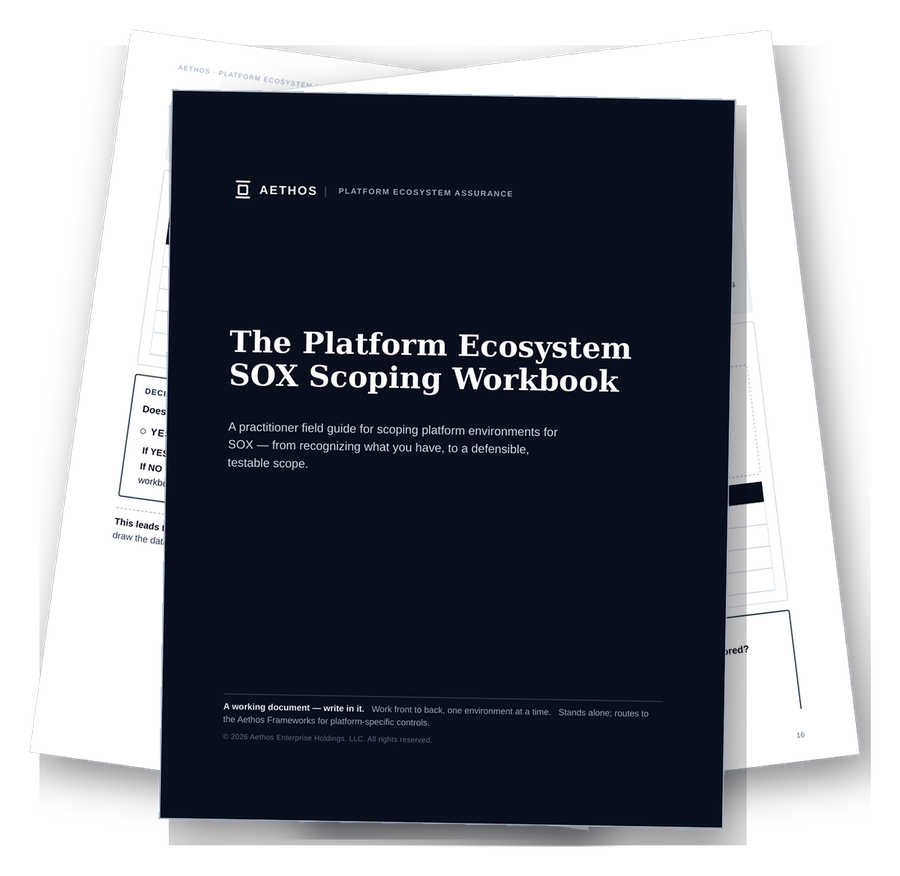
The complete printable method, yours to work through, mark up, and keep as your scoping workpapers.
- All 13 chapters, recognition to testable scope
- One worked example threaded end to end, with diagrams
- Write-in worksheets you keep as workpapers
- The full 10-question diagnostic, self-scored
- Decision gates that route you through every step
The workbook tells you which controls you need. The Frameworks give you those controls.
When you reach the point of "a control belongs here," the Aethos Framework library carries the platform-specific controls, configuration tiers, evidence, and test steps for AWS, Okta, GitHub, ArgoCD, Kubernetes, Databricks, Kafka, Snowflake, and more.
Questions
A 38-page printable PDF: the full 13-chapter workbook with worked examples, diagrams, decision gates, and write-in worksheets. You can print it, fill it in by hand, or annotate it digitally.
Instantly. After checkout you're taken straight to a download page, with no waiting and no email list signup.
No. The workbook is a complete scoping method on its own. The Frameworks are the next layer: the specific controls for each platform you identify. Many people start with the workbook and add Frameworks once they know which platforms are in scope.
It's built for environments with real platform footprint: cloud-hosted finance systems, CI/CD, central identity, data platforms. It's especially useful for pre-IPO and newly public SaaS and cloud-native companies standing up a SOX program.
No. It's an educational and methodological tool. SOX scoping requires professional judgment specific to your organization and the requirements of your external auditor. The full disclaimer is included in the workbook.
There's a 30-day money-back guarantee. If it doesn't help you scope your environment, ask for a refund.
Stop stretching a traditional checklist over a platform environment.
Get the method built for how your systems actually work, and a scope you can defend.
Get the Workbook ($99)This workbook is an educational and methodological tool, not legal, accounting, or audit advice. It does not guarantee any audit outcome or regulatory acceptance. Scoping decisions require professional judgment specific to your organization and the requirements of your external auditor. "Northwind" is a fictional example. Product and platform names are referenced for illustration and belong to their respective owners.